~ Bailey Shawley, M.Ed, CCTS-F, Specialized Parenting & Educational Consultant
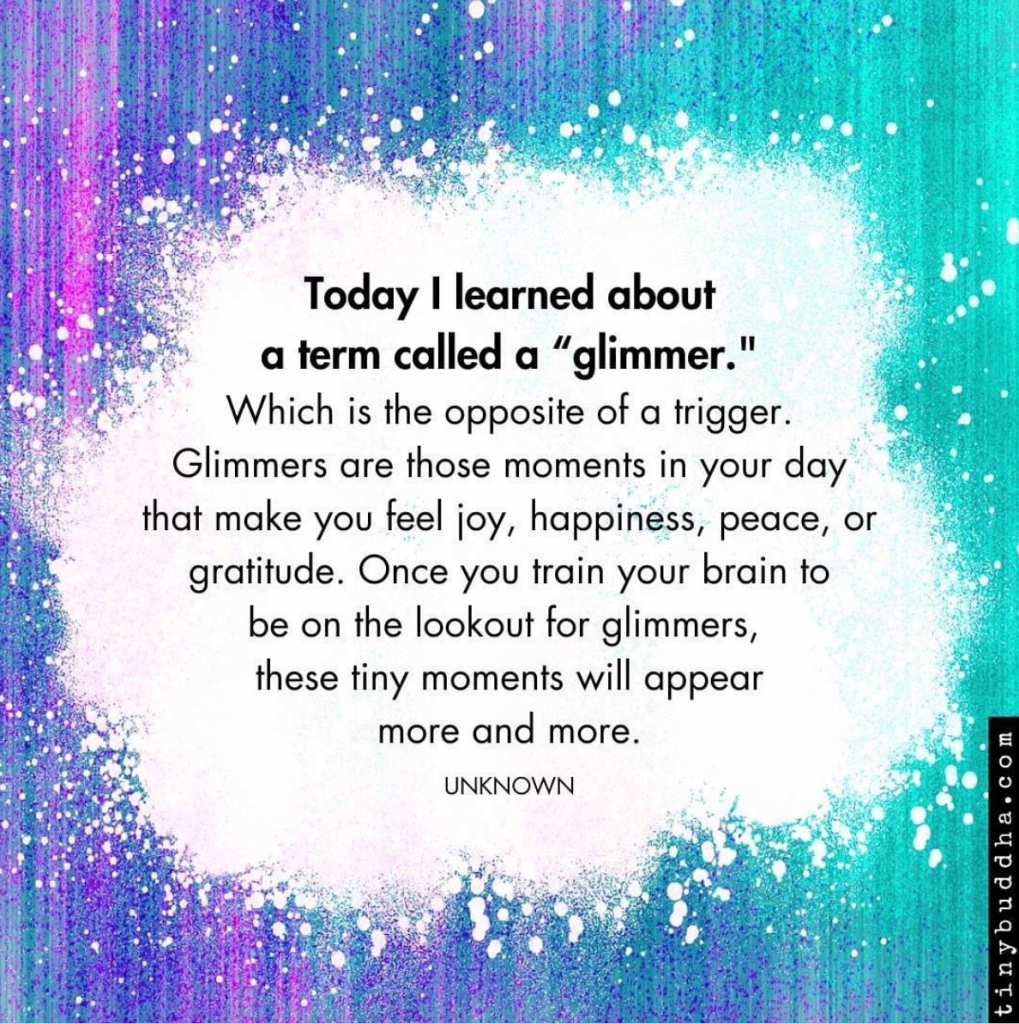
One of my most favorite social media posts that seems to be making the rounds again concerns glimmers. Deb Dana, LCSW, and author of The Polyvagal Theory in Therapy, specialized in complex trauma and coined the term “glimmers” to help her clients verbalize what it felt like to find a “spark in the world” when they felt safe enough to regulate their emotions. Most of us are familiar with the term “triggers,” which are the opposite of glimmers. While triggers lead to emotional dysregulation, glimmers send cues to our nervous system that it is safe to calm and relax. “Triggers” has worked its way into everyday language, and I hope that the social media posts about glimmers are helping them to become just as well known and frequently mentioned.
According to Dana, glimmers can be found around us every day and we “naturally bump into them.” They can be as simple as someone smiling at us or hearing a bird singing. But, Dana reminds us that glimmers are not a part of toxic positivity and are not synonymous with counting our blessings. Rather, finding glimmers feels good and makes us want to find more so we are able to regulate and rise above our trauma. She explains that the glimmers come into our systems and “land” and eventually accumulate, which gives us access to the regulating energy that leads us to feel more present in our lives.
Dana encourages us to find the glimmers that are waiting for us and to follow the basic steps of the glimmer practice: see, stop, appreciate, share, and remember. As Dana explains, noticing, naming, and gathering our glimmers through journaling leads to them nourishing our nervous system. Dana also suggests we use the five categories of glimmers to help us notice them: glimmers in nature, glimmers with pets and people, glimmers in arts and science, embodied glimmers, and flavors of glimmers. And, Dana reminds us: “glimmers are the micro moments that appear all the time, are small enough to reach for, are easily accessible, and come in a variety of different ways, so that everyone has a chance to bump into a glimmer.” Overall, Dana proposes that glimmers not only are good for us, but they are good for the world and are a “foundation for powerful change.”
Glimmers are the micro moments that appear all the time, are small enough to reach for, are easily accessible, and come in a variety of different ways, so that everyone has a chance to bump into a glimmer.
~ Deb Dana, LCSW, Author of The Polyvagal Theory in Therapy
When I first introduce glimmers to clients, I ask them to think about their moments of joy. What makes them feel good, smile, relax, feel safe, etc. I guide them through brainstorming and then help them identify patterns and guide them through categorizing their glimmers. Glimmers are different for everyone, and that’s okay. The most important thing to remember is to engage in your glimmer practice daily. As with any other practice, the more we use it, the easier it becomes and the more it benefits us. Also, be gentle with yourself as you start your practice. Noticing glimmers will take some time, and you cannot force glimmers to occur, just as you cannot force yourself to notice them.
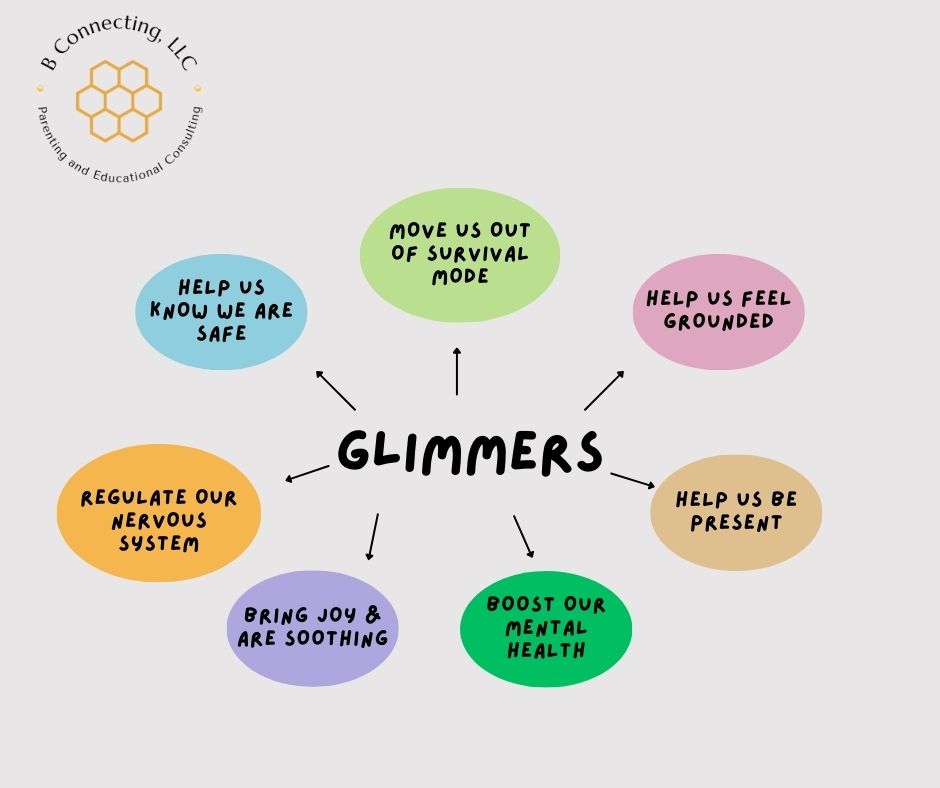
It naturally is easier to notice glimmers when we are mindful and not distracted, and the more we engage in our glimmer practice, the easier it is to be present in the moment. It’s a cycle that works for us instead of against us. Think about it this way. If you are stuck in traffic, you could honk your horn and shake your fist and scream and shout. You could allow yourself to slip into a fit of road rage. You could become stuck in frustration and anger and go into fight or flight mode. Your stress level and blood pressure could increase. None of those reactions benefits your overall health or well-being or changes the traffic situation. Or, you could take a deep breath, close your eyes, and then ground yourself in the present. You may notice that your favorite song is playing. Or that the car in front of you is sporting a funny bumper sticker that you want to share with a loved one. Or that there is an adorable dog wagging his tail at you in the car beside you. Or that a cloud floating overhead looks like a cool object. Or that the sun’s rays are shining vibrantly. You get to choose: react out of anger and frustration and be a detriment to your mental health and well-being, or respond with purposeful presence to notice glimmers and feel soothed and joyful.
If you are a parent or work with children or adolescents, just imagine how powerful a glimmer practice could be for them. It is not about saying their lives are perfect or that everything is wonderful; that’s the toxic positivity Dana cautions us against. Rather, it is showing them that there are joyful moments and occurrences each day and that being open to them, noticing them, naming them, and remembering results in feeling better and calmer. It is acknowledging that even though there are terrible and challenging parts of our day, we can find the bright spots that interrupt the daily grind. How would your conversations at dinnertime or bedtime change if you shared your glimmers? How would your kids’ attitudes change toward school, practice, homework, chores, and all of the other things that they would rather not do, if they engaged in a regular glimmer practice? How would your own well-being change? Give glimmers a try and find out.
If you are ready to learn more about glimmers or would like some guidance in implementing a glimmer practice, reach out to schedule a session. Or, if you struggle to get your child or adolescent started on the path toward noticing glimmers, reach out. The initial consultation is free of charge to ensure we are a good fit for one another, and it is available in person or online. I also provide half-hour and full-hour Reiki sessions, which are very supportive when beginning a glimmer practice. All B Connecting LLC services are confidential and judgment free.