~Bailey Shawley, M.Ed, CCTS-F, Specialized Parenting & Educational Consultant
In yesterday’s blog post, I focused on the need to send clear, consistent messages to our children about our expectations and their behaviors. In order to do that, we need to use the space between being triggered by their behaviors and reacting so that we can self-regulate, respond appropriately, and guide them through co-regulation. Today, I continue my two-part series on the messages we send our children, but this time I focus on the hypocrisy of punishing children with words when they actually do what we want them to do.
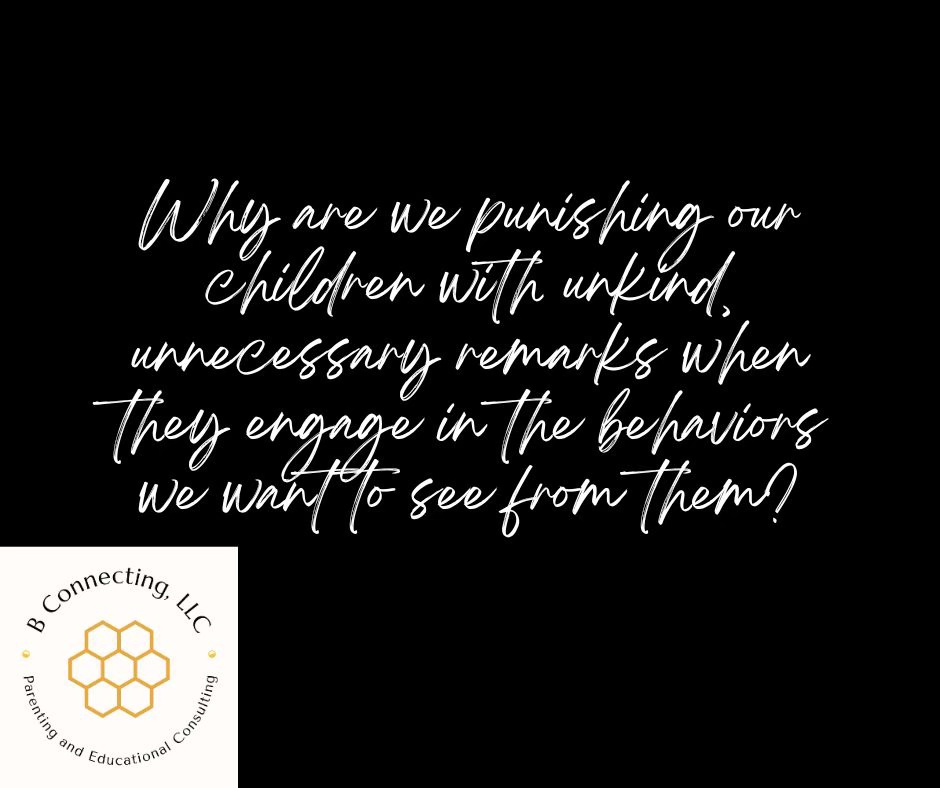
Parents often make snarky remarks to children, and we seem to do it most when they engage in the behaviors we want to see from them. (Read that again.) Whether it’s a part of our personality to be sarcastic and snarky or we think we are proving a point, all we are doing is sending a mixed message to our children. Let’s save the snark for our friends and partners who can grasp the meaning of our words and dish it back to us.
So, if a child who prefers to isolate comes out of their room and a parent says something such as, “Nice of you to join us,” what message does that send? A remark like that mocks the child’s effort to be more social with the family. They hear from the parents all the time about their isolating, but when they try to join the family, the parents punish them with a sarcastic remark. Either way, the child knows the parent will have something unhelpful to say to them, so they might as well continue isolating.
Parents also often make unkind remarks to children when they make improvements or progress in a task or skill that they had been struggling with for some time. For example, a child may remember to empty the dishwasher without being prompted and the parent says, “Why can’t you do that all the time?” The message to the child is that they still aren’t good enough. Imagine how you would feel if you were struggling with a task at work, finally nail it, and your supervisor says, “Why can’t you do that all the time?” The child likely feels even worse because it is their parent saying it.

Another unhelpful word is “finally.” That word completely negates any progress the child has made. Parents tell them in one word that it took them too long to do something that they think the child should have been able to do quickly. Parents send the message that they not only are not proud of the child, but they weren’t sure the child was going to accomplish the task in the first place. By saying “finally” in any sentence to a child, parents show them that they lack confidence in them and do not appreciate their progress or success. Again, parents send the message that the child is not good enough.
As parents, we must be acutely aware of the power of our words – all of them. Our kids’ peers, their own thoughts, and the world at large will do enough damage to their self-esteem and confidence. We should not contribute to that in any way, shape, or form. Avoid any words that make them seem like they are not enough. Use words that uplift your children, celebrate their small steps, and encourage them to move in the right direction. Our kids want to do well and succeed. Our encouraging, supportive words will motivate them. Let’s stop punishing them with our words when they make progress and succeed.
If you struggle with finding the right words for your children, or your children become defensive regardless of what you say to them, reach out to schedule a consultation. The initial, 30-minute consultation is free of charge and available online or in person to ensure we are a good fit for one another. Full-hour consultations for 1-2 people are $50, and full-hour consultations for 3-5 family members are $65. Or, if you are stressed by the communication challenges at home, schedule a half-hour or full-hour Reiki session (in person only). All B Connecting, LLC services are confidential and judgment free.
 B Connecting, LLC