~Bailey Shawley, M.Ed, CCTS-F, Specialized Parenting & Educational Consultant
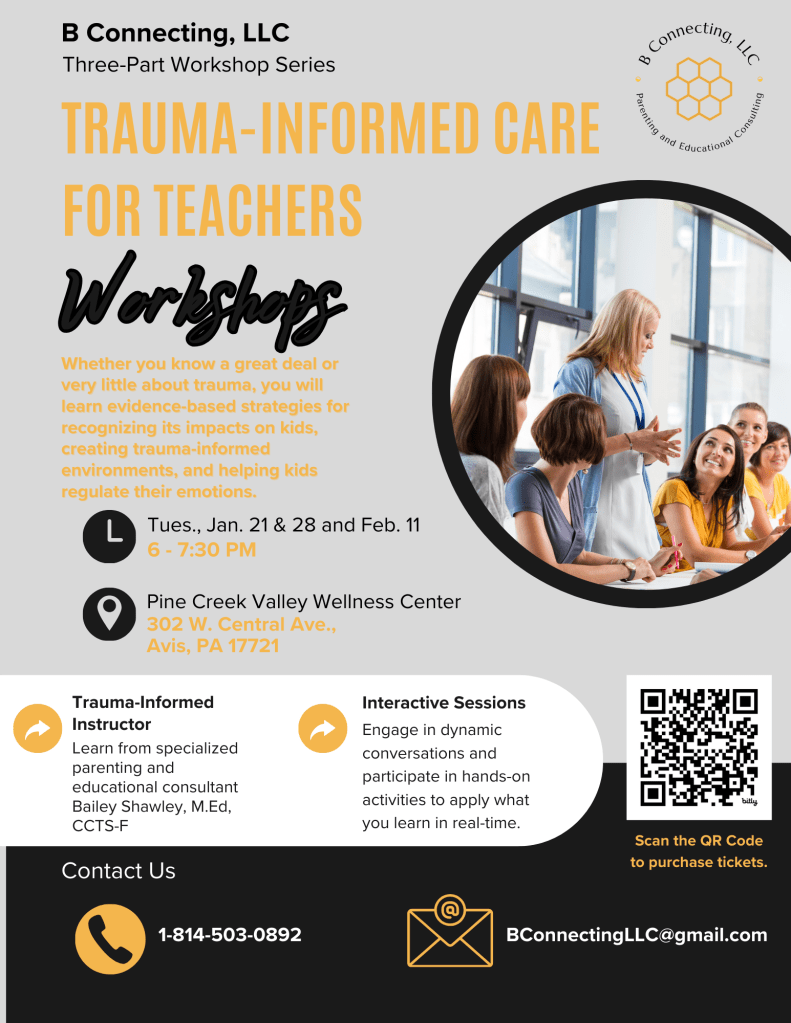
When I first started developing community workshops, I shared a social media poll asking people to vote for the topics most interesting to them. Stress was number one, so I geared the first B Connecting, LLC Workshop toward stress in November 2024. Self-care was number two, and my amazing colleague, Stacy at Enso Counseling & Wellness, LLC, held a sound bath workshop and a vision board workshop in December 2024 and January 2025, and I held more Reiki healing and chakra reading sessions. While it may have made sense for me to make my next workshop about anxiety, the third most-chosen topic, I took a detour and designed Trauma-Informed Care Workshops. Trauma was one of the topics people had chosen in the poll, and it was something that clients had been asking my colleagues and me about, knowing that we had begun offering workshops. So, I was pleasantly surprised when I got some feedback asking when the anxiety workshop would be; but, I also was surprised when I was asked why someone should attend a trauma workshop.
I know the idea of attending evening workshops in the middle of the winter to learn and talk about trauma does not sound fun. But, there is such a need for trauma-informed care that I didn’t feel good about waiting to host the trauma workshops. No, they won’t be as fun as the other workshops, but they will be as casual as possible, discussion-centered, and interactive to make people feel more comfortable talking about such a difficult topic. Lecturing and worksheets aren’t my style, anyway. Despite the fact that they originally were named for educators, the B Connecting Trauma-Informed Care Workshops are appropriate for everyone, because the more I worked to develop and design them, the more I realized that the information and strategies can be used by anyone who interacts with kids.
But, back to the original question: Why should someone attend a trauma workshop? The short answer is, there is a mental health crisis in the United States, particularly for our youth, and the pandemic altered our way of life so much that we all lived through a traumatic experience, even if we never contracted COVID or lost a loved one to it. The better answer is that purposeful, trauma-informed interactions with kids can help heal their trauma, and I strongly believe that educators, paraprofessionals, assistants, daycare workers, social workers, case workers, case managers, juvenile probation officers, parents, and family members need to be trauma-informed to better support our youth. It never hurts to learn evidence-based strategies to recognize the impacts of trauma on kids, create trauma-informed environments for them, and help them regulate their emotions.
As a former teacher, I completely understand the feeling of dread and overwhelm that arises when asked to learn one more thing or do one more new thing in your professional practice. I also understand the hesitancy, or even anxiety, that you may feel when considering addressing mental health because you are not a trained mental health provider. The good news is, I’m not expecting you to learn anything brand new or to be a counselor or therapist. I’m just asking you to consider how being trauma informed can help you better understand the kids for whom you care and support them more fully. And I don’t know one person who works with or interacts with kids who doesn’t want to be able to do that. I also don’t know one person who works with kids who does not enjoy connecting with them and building positive relationships with them: that’s what the trauma workshops will enable you to do on a whole new level.
I am passionate about this because of the work I have the privilege to do with individuals and families. I also wholeheartedly believe that if I had been more trauma informed in my first years of teaching, I would have had an easier time in the classroom. I would have been an even more empathetic and supportive teacher, too. If you’re not ready to delve into trauma just yet, I understand. I simply invite you to consider where you are comfortable starting on your learning path and then pursuing that knowledge however you can. There are several resources you can peruse on your own, and I suggest you begin by clicking the links throughout this post and expanding from there. Trauma is a difficult topic, but we adults do so much more good for our kids when we learn more about it.
Are you struggling with your own trauma history, or are you unsure how to work with kids who have experienced trauma? Reach out to schedule an individual consultation to work with me one-to-one. The initial consultation is free of charge to ensure we are a good fit for one another, and it is available in person or online. You also can schedule a Reiki healing session to de-stress, find peace, and invite more positive energy into your life.