~Bailey Shawley, MSEd, CCTS-F, Specialized Parenting & Educational Consultant
Kids have big imaginations. And big feelings. And that often means that their big feelings come out in big behaviors. When we ask our child why they did something or why they feel a certain way, they can’t always tell us. They don’t always have the vocabularies or emotional intelligence they need to verbalize what is happening, and they don’t always have answers to our big questions. Think about it: Can you always tell someone exactly why you’re upset or what is wrong? So, why do you expect your child to be able to do so?

That’s one of the topics that I address with parents most frequently in consulting sessions: we want answers, and we get stuck in cycles of asking why, but most of the time, our kids truly cannot tell us. That in itself escalates the situation, and if our kids’ behaviors have angered or frustrated us, the conversation can take a turn very quickly. But, we’re parents, and we want to know what is wrong and what is going on, and we feel like we have to ask why? to get anywhere. So, how do we get to the heart of the matter?
Well, the bad news is that we often take approaches that are ineffective. We try to observe our kids and notice when they struggle or are a little “off,” but instead of asking them if they want to talk, we often try to figure it out on our own or make assumptions. We see that they’re tired and blame them for being on their phones or video games too late at night. We hear their attitudes and tones ramp up and assume that they are angry with us and then blame them for being disrespectful. A much more effective first step is to increase our mindfulness as parents and as people. As humans, we have emotional reactions when triggered. If we become mindful of our own feelings and reactions, we can take the pause we need to self-regulate and remind ourselves that most of our kids’ actions and behaviors have nothing to do with us and everything to do with their emotional reactions. That leads to parents being able to think more clearly and less emotionally and to approach our kids with more empathy and curiosity instead of anger and blame.
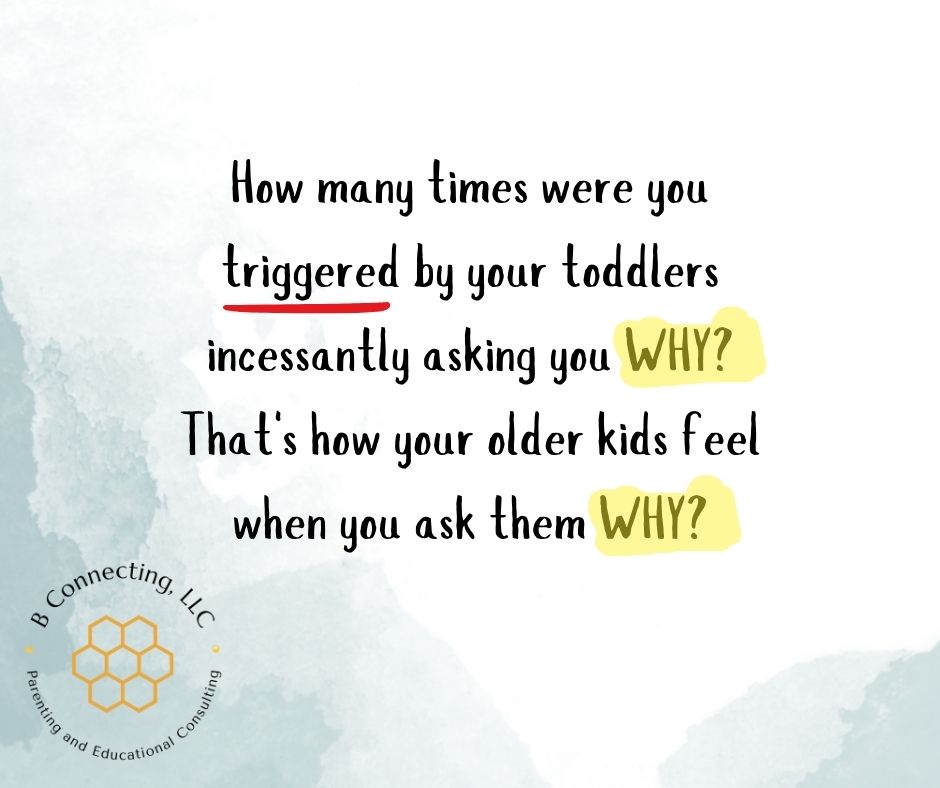
And curiosity really needs to be the next step in getting to the heart of the matter. Remember, though, that it should not involve asking why? – how many times were you triggered by your toddlers incessantly asking you WHY? That’s how your older kids feel when you ask them WHY? Instead of asking, “Why are you acting like this?” it’s much more effective for parents to say, “Hey, I noticed X. Is that true, or is that just what I think is happening?” When you approach your kids this way, you give them a chance to process what is happening while also inviting them to give feedback on their own feelings, behaviors, and perceptions. You are calm, and you are not blaming them. There also is no blame or assumption in the wording, which helps your kids feel like it is “safer” to talk to you.
So, for example, if you want to know why your child is being short with you, and you say, “Hey, I noticed that you’re giving me really short answers lately. Is that true, or is that just how it seems to me?” your child is more likely to tell you if they are or aren’t being short with you. By asking them a curiosity-filled question, we help increase our kids’ mindfulness about their actions. This lays the foundation for better communication because we show our kids that we are ready to listen to them; we are not yelling at them or confronting them, and we show them that we want to have a productive conversation. The beauty of curious questions is that they work for nearly any age, especially for ages five and up.
The next time your child acts out in a big way, practice mindfulness to promote self-regulation to get to a space where you can support them rather than blame or punish them. Then, get curious and tell them what you noticed and ask if that’s really what is happening. You’ll get the information you’re seeking to help them work through their emotions and challenges without breaking down communication or escalating anyone further. When we get to the heart of the matter, we can parent our children with support, understanding, and education so they are better equipped to approach a similar situation in the future with more confidence and ability.
Getting to the point where you can calmly respond to your children, especially if they are struggling and exhibiting challenging behaviors, takes knowledge, patience, and time. When you are ready to learn how to self-regulate and approach your children in productive ways, reach out to schedule a consultation so I can guide and support you through the process. Individual consultations for 1 or 2 people are available in person or online, and group consultations for 3-5 people are available in person only. I also offer 15-30 minute initial consultations free of charge; they are available virtually or in person to ensure we are a good fit for one another. Parents often take advantage of the initial consultation to meet me, ask questions, share details about the challenges without their children being present, and get a feel for how consulting with B Connecting, LLC works. Scheduling for all B Connecting, LLC services is available via the secure client portal, via email to BConnectingLLC@gmail.com, or via phone to 814.503.0892.

 B Connecting, LLC