~ Bailey Shawley, M.Ed, CCTS-F, Specialized Parenting & Educational Consultant
My family went for dinner the other night. We chose a well-loved restaurant in the center of town where a lot of families go. Several families, a few older couples, and a handful of college students were there. And, nearly every diner was on a screen. Young children watched videos, tweens and teens listened to music and watched YouTube or played games, and adults were scrolling, shopping, and sharing memes. It was the oldest people in the room who were not on their screens: to be honest, a couple were, but not many.

Our apparent need for, or obsession with, screens is not new. Child development experts, education experts, and pediatricians caution that our kids don’t know how to self-soothe, have short attention spans, struggle with mental health issues, and cannot handle boredom because of screen time. Chiropractors and orthopedic surgeons see patients who have pain in their neck, shoulders, and back because they hunch over their electronic devices all day. There are reports of people walking into things because they are looking at their phones instead of where they are going. And we all are well aware of the dangers of texting while driving.
No, it was not the fact that so many people of nearly all ages were on their phones that bothered me. Rather, it was the thought that when we are attached to our devices 24/7, we are not present in our own lives. Worse yet was the realization that we are teaching our kids not to be present in their own lives, either. When we watch videos, go down a rabbit hole, or scroll endlessly, we don’t participate in real life. We don’t make eye contact. We don’t engage in discussions and conversations. We don’t connect on a personal level. All of this means we don’t model those oh-so-important social behaviors for our children. And we aren’t there in the ways that our children, or even ourselves, need us to be.
And it’s not just happening at restaurants while people wait for their food. At the park the other day, I lost count of how many times I heard kids around us yell, “Mom! Mom! Mom! Look!” and “Hey, Dad! Watch me!” When I looked toward the parents, I saw them on their phones. They were not pushing their kids on the swings. They were not holding down an end of the see-saw. They were not spotting their children on the bars. And they were not sharing in their kids’ accomplishments, pride, or joy because they were on their phones instead of paying attention to or engaging with their kids.
We’re all guilty of it. As small business owners, my husband and I get alerts and notifications from customers and clients frequently. He needs to complete orders on time, or he won’t have the products his customers and their animals and livestock need. I need to confirm appointments, or my clients won’t get the support they need. But, we also need to be present for our sons, and the more time we spend on our phones during family time, the more they follow our lead. That means we need to step up as the adults in the family and make some changes to benefit everyone’s well-being.
And that’s why I, while at the restaurant with my family, put down my phone first and asked my husband and our sons to do the same. We then played a word scramble game (I travel with a pen, and we use paper napkins or placemats). Families with younger children could play I Spy, find objects that start with specific letters, draw, or color. Other fun games that can be adapted for kids of various ages include playing Would You Rather, guessing how many people will come into the restaurant in a certain amount of time, or guessing the order in which other diners will get their food. I also encourage our sons to bring along their books to restaurants where the wait tends to be longer.
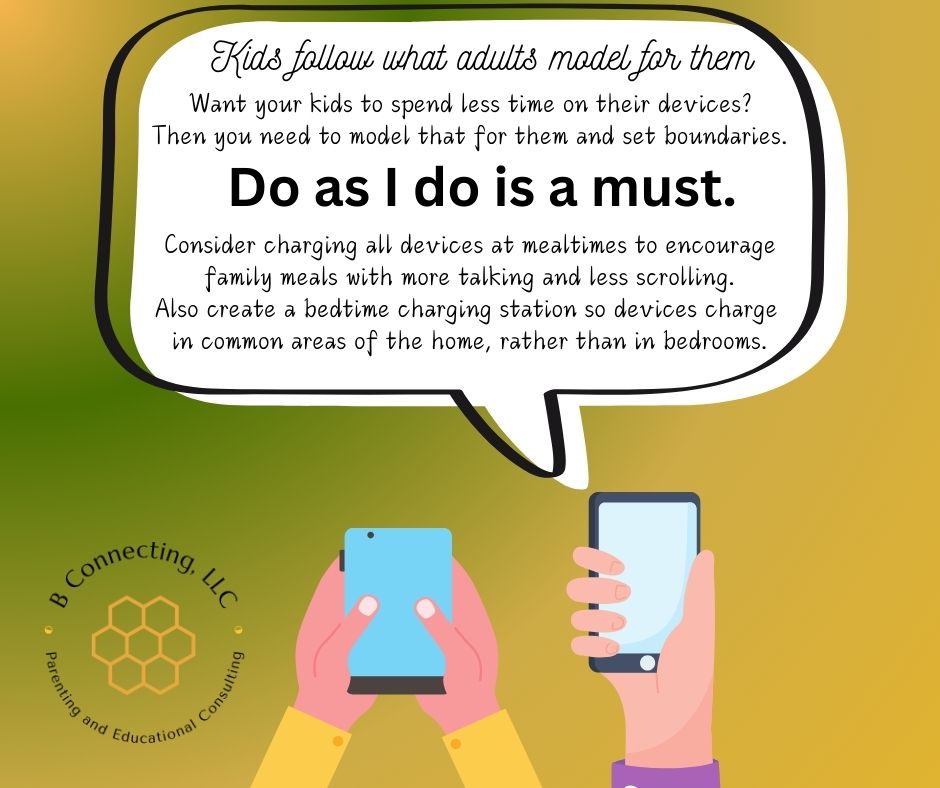
As with any behavioral changes, reducing and limiting screen time will take some thought and intentional practice in addition to some patience. Setting initial expectations and boundaries will be helpful for everyone, and it will make it easier for everyone to be accountable. So, yes, that means that parents need to follow their own rules and model for their kids when it comes to devices. Do as I say and not as I do will never work.
I often suggest that families begin by having a no-phones-during-mealtime rule. Mealtime is an opportunity to talk and connect, and it’s easier for families with older kids to engage with one another when they are involved in another activity, like eating. I also encourage families to consider limiting phones while cooking, too, because working as a family to prepare a meal provides learning opportunities and more time to talk. It’s also a good time to charge phones, too. If you use your phone or other device for recipes or instructions, show your kids how to put it in a central location and use it for that purpose only. Avoid scrolling while things are cooking. Instead, use that time to work as a family to set the table, gather condiments, and fill glasses while checking in with them about their day.
The next suggestion I offer to families attempting to reduce screen time is to ban phones from bedrooms. Keeping your kids’ devices out of their rooms will help them unplug literally and figuratively, so they get a break from the blue light and distractions their phones provide. No phones in bedrooms also helps kids avoid cyberbullies, internet predators, and other safety concerns that can occur when kids use electronic devices while unsupervised. If your child requires a noise machine or music to sleep, consider using a voice-activated device rather than one with a screen. As for you, you’ll soon find that you fall asleep more quickly and sleep more soundly if you aren’t engaging with work, scrolling mindlessly, or getting into a battle with a keyboard warrior late at night on your phone.
Best of all, unplugging at nighttime means being more present. When you all unplug at night, families are able to engage in more quality time by being in the moment together. You can play games, read stories, color or draw, or do other age-appropriate, fun activities as a group. Device-free nights also give families time to engage in self-care strategies such as personal hygiene routines (without rushing), family yoga or stretches or meditation, or calming breathing. You’ll also increase communication and enhance connection. Just imagine how much better everyone will feel and sleep if you implement device-free family nights. You’ll increase presence and mindfulness in everyone, which will lead to reduced stress and anxiety, improved relaxation, and a more calm environment.
If you worry about how much time your kids spend on their screens or need support and guidance in improving your presence and mindfulness, reach out to schedule a consultation. The initial consultation is free of charge to ensure we are a good fit for one another, and all B Connecting, LLC services are confidential and judgment free. I also provide Reiki healing sessions, which are beneficial for people struggling with improving mindfulness and being present.